


The Surprising Reason Your Low Back Feels Unstable
Posted In
August 19, 2025
Posted On
Fun fact: Muscles can actually “fall asleep” if they’re held in a lengthened position for too long. It’s called autogenic inhibition—a protective reflex where your body dials down muscle activation to avoid damage. While this is a natural safeguard, when it happens to key stabilizing muscles in your low back, it can create real problems over time.
The Low Back’s Vital Role
Your low back, also called the lumbar spine, has three essential jobs:
- Support the upper body and absorb axial forces from the head, neck, and trunk.
- Protect the spinal cord before it branches to the lower body.
- Allow movement—including flexing, extending, side bending, and rotating the trunk.
The natural curve in your low back—known as the lordotic curve—is key to all of these functions. Without it, stability and efficiency suffer.
The Common Mistake: Flattening the Curve
Many of us have been told to “protect” our low back using cues like:
❌ Tuck your tail
❌ Press your low back into the floor
While these instructions may have good intentions, they create a posterior pelvic tilt—think of your pelvis like a bowl of cereal tipping backward, spilling milk out the back. This flattens your lumbar curve, and here’s the problem:
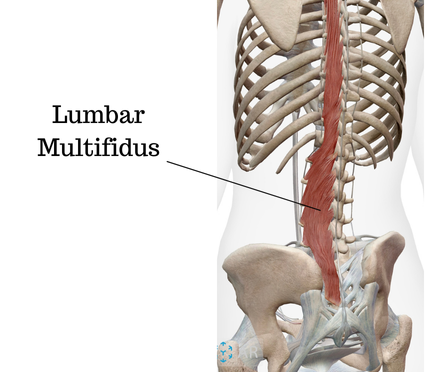
The multifidus, small but powerful spinal stabilizers, are the only muscles that provide direct segmental support to the lumbar spine. Holding a tucked pelvis for extended periods can lengthen and inhibit these muscles through autogenic inhibition. Over time, this reduces support and can destabilize the spine—the exact opposite of what we want.
The Better Approach
I’m not saying you should never round your spine—there’s a time and place for it. But flattening the curve shouldn’t be your default, especially if you’re trying to “protect” your back.
💡 Quick Tip: Instead of “tuck your tail,” try the cue “hips even” to find a more neutral pelvis.
How We Apply This in Sessions
When I work with clients, we focus on:
- Building pelvic awareness—knowing where your neutral position is and how it changes in different movements.
- Strengthening the lumbar extensors to support the spine.
- Understanding that perfect posture doesn’t exist—what matters is the ability to sense your position and adjust with purpose.
Try This: Pelvic Awareness Drill
- Lie on your back with knees bent, feet on the floor.
- Notice the small space between your low back and the floor.
- Gently rock your hips forward and back:
- Tuck to press your low back into the floor, then relax.
- Tilt the other way, letting your low back lift slightly as your pubic bone reaches forward, then relax.
- Repeat slowly for a few rounds, focusing on sensation, not force.
Bottom line: Your low back’s natural curve is part of how your body is designed to move and support you. Respect it, strengthen it, and build awareness—your spine will thank you.


