


How Movement Helps Your Body Heal From Pain and Injury
Posted In
September 21, 2026
Posted On
When I tell people I offer private yoga for pain management, I sometimes get met with a confused stare. So, let’s talk about how movement helps your body heal and what that actually looks like in my sessions.
In the beginning, my sessions do not typically follow a standard yoga class. I also do not give everyone with knee pain the same knee exercises and send them on their way. Instead, we look at how your whole body is moving, what may be contributing to the pain and what creates a meaningful change.
Here is the big idea behind my work:
Movement is not separate from healing. Movement is one of the ways your body heals.
That does not mean more movement for the sake of moving or pushing through pain. It means finding the right movement to help your body heal and feel safe moving again.
Your Body Needs Movement
Your body is designed to move, all the way down to the cellular level.
When your muscles contract, they help circulate blood and support the movement of lymphatic fluid. Unlike your circulatory system, which has the heart acting as a central pump, your lymphatic system relies on movement, muscle contractions and breathing to move fluid through the body. You can read more about how muscle contractions support the physiology of the lymphatic system.
Movement also helps nourish your joints. Synovial fluid acts a little like the WD-40 of the body, helping your joints move smoothly. Moving your joints helps stimulate the production and circulation of synovial fluid. Because cartilage does not have its own direct blood supply, loading and unloading a joint helps move fluid and nutrients through it. Think of it like a sponge: pressure pushes fluid out, and releasing that pressure allows fluid to move back in. Research on cartilage and cyclic loading supports this relationship between movement and nutrient exchange.
Movement also helps keep your fascia and other tissues hydrated so they can glide across one another. When you stop moving an area, the fascia can become sticky, the tissues do not glide as well and you may begin to feel stiff, restricted or stuck.
The point is: movement is not just something your body can do. It is part of how your body stays healthy and heals.
Pain Changes How You Move
When something hurts, your body tries to protect it. You may shift your weight, shorten your stride, hold your breath, grip around a joint or ask another muscle to take over. At first, that is a smart response.
If you sprain your ankle, limping helps you get home without putting your full weight on an injured joint. The problem comes when your body keeps using that strategy after the injury has healed. Your nervous system is very good at repeating what has kept you safe before.
Over time, gripping and compensating can create more tension, restriction and pain. That pain tells your body it still needs protection, so it grips even more.
This is the pain cycle:
Pain creates protection. Protection changes movement. Changed movement creates more pain.
This is also why treating only the painful spot does not always create lasting relief.
For example, an old big toe injury that made you walk differently for a while may actually be contributing to your knee pain. Treating the knee without addressing the restriction in your big toe may offer temporary relief, but it will not create lasting change.
You can read more about these connections in my article about foot stability and whole-body movement.
How I Use Movement to Help You Heal
The goal is not simply to move more. It is to find the right movement for your body.
First, we look at the patterns underneath your pain. Where are you gripping? What movement are you avoiding? Which muscles are doing more than their share of the work? What happens when we make one small change?
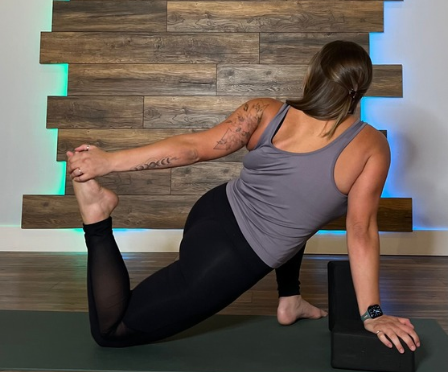
Then, we may use breathwork, self-release and specific resets to give your body another option. We test the movement again and see what changed. This part of a session may feel less like a traditional yoga class and more like solving a body puzzle together.
As we learn what works for your body, we can bring those changes into a fuller yoga or movement practice. You begin to understand what you are feeling, what your body needs and what you can do when pain shows up.
That is how movement helps your body heal: by giving you more options and helping you understand what your body needs. I do not want you to feel like you need a practitioner every time something hurts. I want you to have tools, options and a better understanding of your own body. I want you to be able to get on the ground and play with your kids, go on a hike with your spouse or drive a few states away to see a friend without worrying about how you are going to survive the next day.
Ready to Trust Movement Again?
Healing does not happen by avoiding movement and waiting for pain to disappear. It happens by teaching your body how to move well and trust movement again.
If pain has changed the way you move, let’s look beyond the painful spot and figure out what your body needs. Book a free consultation to tell me what is going on and see if private yoga or pain management is the right fit for you.
Pin
Share


