Jaw and Pelvis Connection: Can Your Jaw Affect Your Hips?
Posted In
August 20, 2026
Posted On
Your jaw and pelvis are connected—and that connection influences how your body creates balance, pressure and stability.
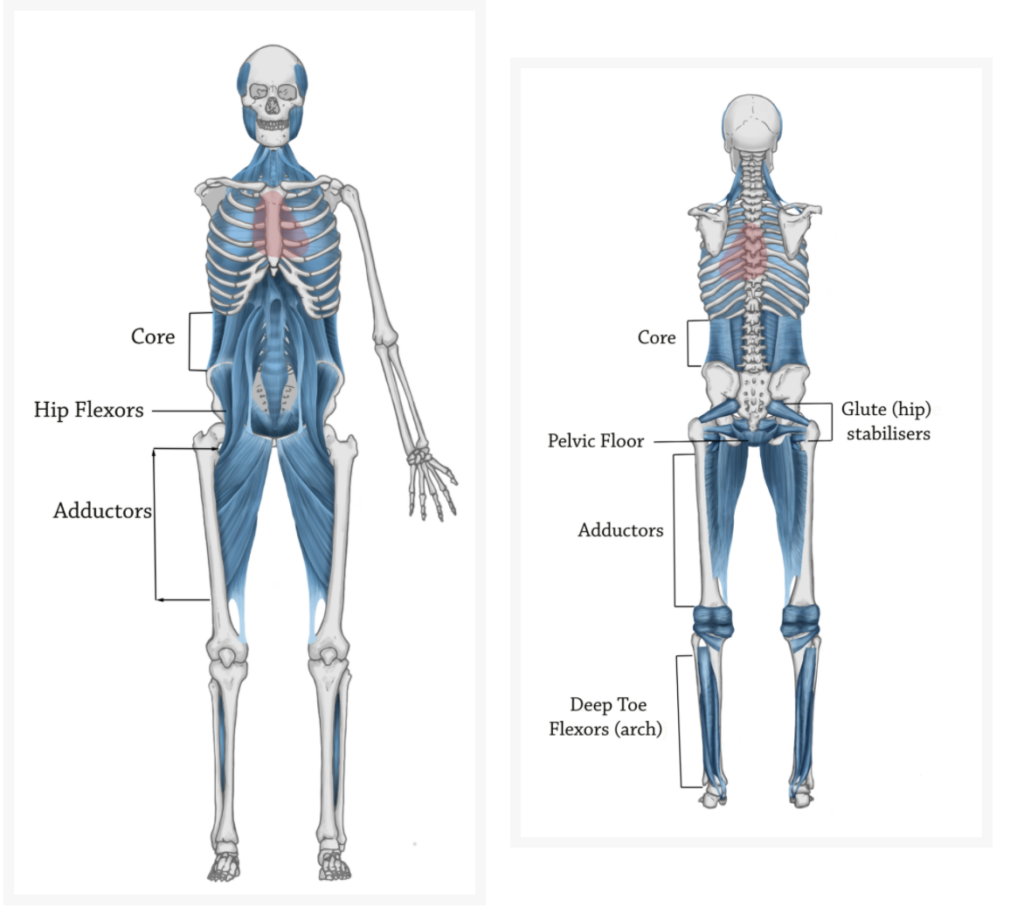
Although they may seem like distant neighbors, your nervous system does not organize them as completely separate parts. Sensory information from your jaw affects how your brain understands your position and coordinates movement throughout your body. At the same time, your jaw, abdominals, hips and pelvic floor can work together as part of one whole-body bracing strategy.
This is why changing someone’s jaw position can immediately change their balance, strength or hip mobility.
The jaw won’t be the primary driver of every hip or pelvic problem. But the jaw and pelvis connection is real—and when changing the jaw repeatedly changes someone’s movement, it deserves our attention.
Your Jaw Helps Your Brain Locate You
Your jaw-closing muscles have a very high density of proprioceptors—sensory receptors that tell your brain about position, movement and force.
As a result, your nervous system closely tracks:
- Where your jaw is positioned
- How it is moving
- How much force it is producing
Your brain then combines this information with input from your eyes, inner ear and the rest of your body to organize balance and movement.
In other words, your jaw does much more than chew. It provides information your brain uses to organize your entire body.
That’s why changing your jaw position can change the way you stand, sway or recruit muscles elsewhere.
Why We Clench for Stability
We often clench our jaw without realizing it—especially when we’re stressed or our body is searching for stability.
Clenching increases muscular recruitment and can make the body more stable. For example, that can be useful when you’re lifting something heavy, bracing for impact or producing a large amount of force.
Research has found that jaw clenching can improve stability during certain balance tasks. Additionally, different jaw positions can affect standing postural control.
So, if your body doesn’t feel secure, clenching can become a strategy for creating that missing stability.
However, a strategy designed for maximum effort isn’t one you want to use all day.
If you’re clenching while standing, driving, exercising or answering emails, your body may be using tension to hold itself together. Over time, that tension can become part of a larger bracing strategy involving your:
- Abdominals
- Hip flexors
- Pelvic floor
This doesn’t mean everyone who clenches has a tight pelvic floor. Instead, it means the jaw and pelvic floor can participate in the same whole-body response to stress, instability and effort.
Understanding the Jaw and Pelvis Connection
The jaw and pelvis connection has long been recognized in birth work, osteopathic medicine, Eastern medicine and other whole-body therapeutic practices.
For instance, midwives commonly encourage laboring people to soften their jaw, relax their tongue and make low sounds to help the pelvic floor release. This is not a random relaxation cue. The jaw and pelvic floor participate in related systems of breathing, pressure management and muscular bracing.
Their relationship can be understood through:
- Fascial connections
- Embryological development
- The digestive canal
- The body’s interconnected diaphragms
- Breathing and pressure regulation through the trunk
- Whole-body neurological and muscular bracing strategies
In the osteopathic five-diaphragm model, the tongue and floor of the mouth are considered alongside the thoracic outlet, respiratory diaphragm and pelvic floor. Together, these structures contribute to pressure management, postural support, breathing and fluid movement.
The jaw is not mechanically pulling on the pelvis like a puppet string. Instead, both areas participate in the same interconnected system. When sensory input, breathing pressure or muscular tension changes in one area, the nervous system reorganizes the rest of the body around that change.
Research into the exact mechanisms is continuing to develop. Even so, one study found that temporomandibular soft-tissue treatment improved participants’ ability to relax their pelvic-floor muscles.
In other words, the research is catching up to a relationship that whole-body practitioners have observed clinically for a long time.
Where We Get It Wrong
We tend to treat the body as a collection of separate problems.
Jaw pain? Focus only on the jaw.
Hip pain? Work only on the hip.
Pelvic-floor tension? Address only the pelvis.
But your brain is coordinating one body—not a collection of unrelated parts.
Frequently, the area that hurts is the area working hardest to manage a larger pattern. It may be compensating for instability, tension or altered sensory information coming from somewhere else.
That’s why chasing the painful area can provide temporary relief without changing the pattern that keeps recreating the pain.
By contrast, my approach to pain management and private movement sessions looks beyond the symptom so we can identify what is driving the larger movement pattern.
Putting the Connection to the Test
If someone comes into the studio with jaw tension and hip or pelvic pain, I assess the jaw as part of the whole-body pattern.
From there, we test what happens when its position or level of tension changes:
- Does shifting the jaw change balance?
- Does relaxing it make a movement feel weaker?
- Does clenching make a side plank significantly stronger?
- Does addressing the jaw change hip mobility or strength?
- Does the same response happen repeatedly?
In NeuroKinetic Therapy, we also assess whether the direction of the jaw dysfunction corresponds with the way the pelvis and body are organizing movement.
For example:
- Side-to-side jaw deviations often accompany lateral, or side-to-side, movement dysfunction.
- Forward-and-back jaw patterns can correspond with anterior or posterior pelvic organization.
These relationships are not assumptions or one-size-fits-all rules. Instead, we test them in the individual body in front of us.
One result is interesting. However, an immediate change that can be repeated is meaningful.
When changing the jaw repeatedly changes someone’s balance, strength or mobility, it shows us that the jaw is participating in the way their nervous system creates stability.
Once we identify that the jaw is driving the dysfunctional pattern, we release the overworking jaw muscles, activate the under-recruited muscles and retrain the pattern.
Ultimately, the goal isn’t simply to loosen a tight jaw. It’s to give the nervous system a more efficient strategy so it no longer needs to rely on the same compensation.
Try This at Home
Stand with your feet planted and, if it feels safe, close your eyes.
- First, shift your jaw gently to the left. Does your body sway left?
- Next, shift it to the right. Does your body follow?
- Finally, compare the two directions. Does one feel easier or create a stronger response?
Your jaw isn’t physically pulling your body from side to side. Rather, your nervous system is responding to sensory information from your jaw and reorganizing your balance around it.
The goal isn’t to move “correctly.” It’s to notice whether you can feel the relationship—and whether your body responds differently on each side.
The Takeaway
Your jaw affects more than your ability to chew. It provides sensory information that helps your nervous system organize balance, strength and movement.
Clenching creates stability and allows you to recruit more force. However, when your body relies on that strategy throughout the day, the jaw can become part of a larger bracing pattern involving your abdominals, hips and pelvic floor.
Your jaw won’t drive every hip or pelvic problem. But when changing the jaw consistently changes your movement, it is not a coincidence. It is an important piece of the pattern—and one worth addressing.
Ready to Connect the Dots?
If you’re dealing with jaw tension alongside hip pain, pelvic tension or changes in balance, those symptoms may be part of the same movement pattern.
During a comprehensive assessment, we can test exactly how your jaw affects your movement and determine whether the jaw and pelvis connection is relevant to your body.
Book a free phone consultation to tell me what’s going on and find out whether working together feels like the right next step.