Low Back Pain: Are You Really Protecting Your Low Back?
Posted In
August 19, 2025
Posted On
If you deal with low back pain, you may have been told that protecting your back means tucking your pelvis or pressing your low back into the floor. But is flattening your lumbar spine actually making it more stable?
Fun fact: Muscles can “fall asleep” when you hold them in a lengthened position for too long. This process, called autogenic inhibition, is a protective reflex that reduces muscle activation.
While this reflex serves a purpose, decreased activation in key stabilizing muscles can affect how your low back supports you.
Why Your Low Back Curve Matters for Low Back Pain
Your low back, also called your lumbar spine, has three essential jobs:
- Support your upper body and absorb forces from the head, neck, and trunk.
- Protect your spinal cord before the nerves branch out to your lower body.
- Move your trunk through flexion, extension, side bending, and rotation.
Your lumbar spine naturally has a slight inward curve called a lordotic curve. That curve plays an important role in how your spine manages force, creates stability, and moves efficiently.
Understanding this curve can be especially helpful if you’re trying to understand your low back pain and how your movement patterns may contribute to what you’re feeling.
Could Your Pelvic Position Contribute to Low Back Pain?
Many of us have heard cues like:
❌ Tuck your tail
❌ Press your low back into the floor
These cues create a posterior pelvic tilt. Imagine your pelvis as a bowl of cereal and you’re tipping the bowl backward, spilling the milk out the back.
As your pelvis tips backward, your lumbar curve begins to flatten.
That isn’t inherently bad. Your pelvis and spine should be able to move in this direction. However, problems can arise when we repeatedly hold this position because we believe a flat low back is somehow safer or more protected.
What Happens to Your Low Back Muscles?
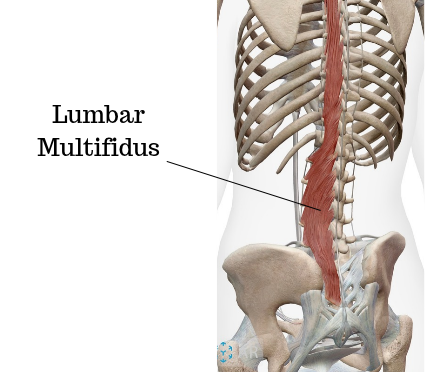
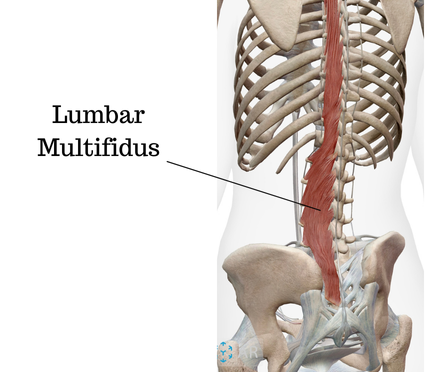
The multifidus muscles are small, deep muscles that run along the spine and play an important role in segmental stability.
When you consistently tuck your pelvis and flatten your lumbar spine, you change the position and recruitment of these stabilizing muscles. Over time, this may make it harder for them to contribute effectively to spinal support.
In other words, constantly flattening your low back may not provide the “protection” you think it does.
And if you’re experiencing low back pain, constantly trying to flatten or protect your spine may not address what’s actually contributing to your discomfort.
Find Your Neutral Pelvis Instead
I’m not saying you should never round your spine or tuck your pelvis. Your spine should be able to move in lots of different directions.
Instead, I want you to stop assuming that flattening your low back automatically makes it safer.
💡 Quick Tip: Instead of thinking “tuck your tail,” try the cue “hips even” when you want to find a more neutral pelvis.
How We Work on This in Private Yoga Sessions
In our sessions, we don’t chase one “perfect” posture. Instead, we work on your ability to recognize where your body is in space and intentionally change your position when you need to.
That may include:
- Building pelvic awareness so you can recognize neutral, anterior, and posterior pelvic positions.
- Strengthening and activating your lumbar extensors to support your spine.
- Practicing different spinal positions so your body has options rather than relying on one movement strategy.
Ultimately, the goal isn’t perfect alignment. It’s having the awareness and control to move your body with purpose.
Try This Pelvic Awareness Drill for Low Back Support
Lie on your back with your knees bent and your feet on the floor.
First, notice the small space between your low back and the floor.
Then, gently rock your pelvis forward and backward.
Tuck your pelvis and feel your low back move toward the floor. Relax.
Next, tilt your pelvis in the opposite direction, allowing your low back to lift slightly away from the floor as your pubic bone reaches forward. Relax again.
Slowly move between the two positions for a few rounds.
Don’t force either position. Simply notice how your pelvis moves and how your low back responds.
That awareness is where better movement starts.
Bottom line: If you’re dealing with low back pain, your goal shouldn’t be to hold your spine in one “perfect” position all day. Your low back has a natural curve for a reason. Learning how your pelvis and lumbar spine move—and how to intentionally control them—gives your body more options.
Ready to Feel More Confident in Your Body?
If low back pain is keeping you from doing the things you love, let’s figure out what your body is asking for. Book a free phone consult and we’ll chat about what you’re experiencing and whether working together is a good fit.
Not ready to book? Join my email list for practical tips on pain, movement, and caring for your body delivered straight to your inbox.